
Home / HR guides / AI in HR and recruitment
HR guide
AI in HR and recruitment. Help with drafting, not with deciding.
AI assistants such as Claude, ChatGPT or Gemini quickly write job ads, job descriptions and answers for employees. Decisions about people stay with people. What you can delegate, what you should not put into them and what the law requires.
Last reviewed: 10.11.2026
What you can delegate
AI writes the first draft. You decide.
AI assistants are good with text: they structure, summarise and rephrase. Check the result before it goes any further.
01 / Recruitment
Job ads and job descriptions.
The first draft of a job ad, a job description or interview questions, based on the requirements of the role.
02 / Communication
Clear messages.
Internal announcements, answers to frequent questions, summaries of the internal regulations, in plain language.
03 / Documents
Procedures and policies.
The structure of an onboarding procedure or a remote work policy, which you then check with your lawyer.
04 / Analysis
Summaries and comparisons.
The summary of a report or an internal survey, without data that identifies employees.
What you do not delegate
Three things you do not delegate.
01 / The decision
Who is hired or dismissed.
AI can suggest; a person decides. GDPR (art. 22) protects people from decisions based solely on automated processing.
02 / Emotions
How employees feel.
Since 2 February 2025, the AI Act prohibits inferring emotions in the workplace, except for medical or safety reasons.
03 / Data
Personal ID numbers, health, salaries.
Do not enter them into a public AI assistant. For examples, use test data, such as Ana Popescu.
What the law requires
GDPR and the AI Act, in brief.
The rules that matter for HR and when they apply.
| Rule | What it means for HR | Applies from |
|---|---|---|
| GDPR, art. 22 | Candidates and employees have the right not to be subject to a decision based solely on automated processing that significantly affects them. A person checks and decides. | 25 May 2018 |
| AI Act, art. 5 | Using AI to infer employees’ emotions in the workplace is prohibited, except for medical or safety reasons. | 2 February 2025 |
| AI Act, art. 4 | A company that uses AI takes measures so that the people who work with it understand how it works and what its risks are. | 2 February 2025 |
| AI Act, Annex III | AI systems used in recruitment, selection, promotion or performance evaluation are high-risk. The obligations for them were postponed by Regulation (EU) 2026/1744. | 2 December 2027 |
In Creasoft HR
AI only as a fallback. Validation stays with HR.
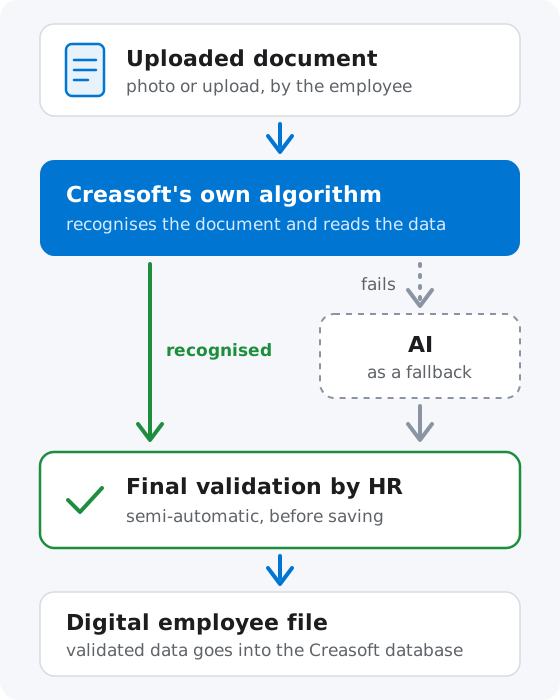
For documents uploaded by employees, Creasoft’s own algorithm recognises the document and reads the data. Only when the algorithm fails is the data read with the help of AI, as a fallback.
HR does the final, semi-automatic validation of the data read. Creasoft HR makes no automated decisions about employees.
Simple rules
Five rules for prompts in HR.
- Give the context: the company, the role, the tone and the length you want.
- Replace names and personal data with test data.
- Ask for options, not the final answer: two ads, three wordings.
- Check every figure, legal article or deadline. AI assistants can be convincingly wrong.
- Keep the decision and the signature with a person.
Example prompt
„Write a job ad for a production operator in Sibiu, three-shift schedule, 150 words, friendly tone, with no requirements related to age or gender.”
Last reviewed: 10.11.2026. Informational material; it does not replace legal analysis for your company’s situation.
Frequently asked questions.
Can I use ChatGPT, Claude or Gemini in recruitment?
Yes, for drafting: job ads, job descriptions, interview questions, messages to candidates. Do not let the assistant decide on its own who moves forward. Enter CVs with personal data only into a business service, with a data processing agreement and a guarantee that the data is not used to train the model.
Is it legal to screen CVs with AI?
GDPR (art. 22) gives candidates the right not to be subject to a decision based solely on automated processing that significantly affects them. The exceptions are limited and require safeguards: human intervention and the candidate’s right to express their point of view and to contest the decision.
From 2 December 2027, AI systems used in recruitment and selection also fall under the AI Act rules for high-risk systems.
What does the AI Act prohibit in the workplace?
Since 2 February 2025, using AI to infer employees’ emotions in the workplace is prohibited, for example from facial expressions or voice. Systems used strictly for medical or safety reasons are exempt.
When do the AI Act rules for recruitment and evaluation apply?
AI systems used in recruitment, selection, promotion or performance evaluation are classified as high-risk (Annex III). The obligations for them apply from 2 December 2027. The original deadline was 2 August 2026 and was postponed by Regulation (EU) 2026/1744, published in the Official Journal on 24 July 2026.
What data should I not enter into an AI assistant?
Personal ID numbers, medical data, named evaluations, individual salaries and data about the employee’s family. If you need an example, use test data.
What does AI literacy mean?
The AI Act (art. 4) requires companies that use AI to take measures so that the people working with it understand how it works, where it can go wrong and what its risks are. A short training session and written internal rules for using AI assistants are a good start.
Does Creasoft HR use artificial intelligence?
Only as a fallback, when reading documents uploaded by employees: Creasoft’s own algorithm recognises the documents, and AI steps in only when the algorithm fails. HR does the final, semi-automatic validation of the data. Creasoft HR makes no automated decisions about employees.
HR without repetitive work.
Creasoft HR generates documents from your templates, sends them for signature and archives them. Decisions stay with people.
Or call sales: +40 749 500 400