
HR guide
How time tracking is done. The same day, three ways.
We followed a single working day through a paper attendance register, an Excel time tracking table and an online attendance register. The differences show up in the exact time, in overtime and at the end of the month.
Free, in Excel, no sign-up.
The test day
Ana arrives at 07:56 and leaves at 16:04.
Her schedule is 08:00-16:00. On Wednesday she stays two hours longer, with her manager’s agreement. This is the same day in each version.
1 / On paper
The attendance register.
Ana signs on arrival and on departure. The register usually shows the schedule: 08:00-16:00. The few extra minutes are lost, and so is the overtime, unless someone notes it separately.
2 / In Excel
The time tracking table.
The team leader fills in the table in the evening or at the end of the week, often with just the figure 8. The formulas add up correctly, but you cannot see who changed a cell or why.
3 / Online
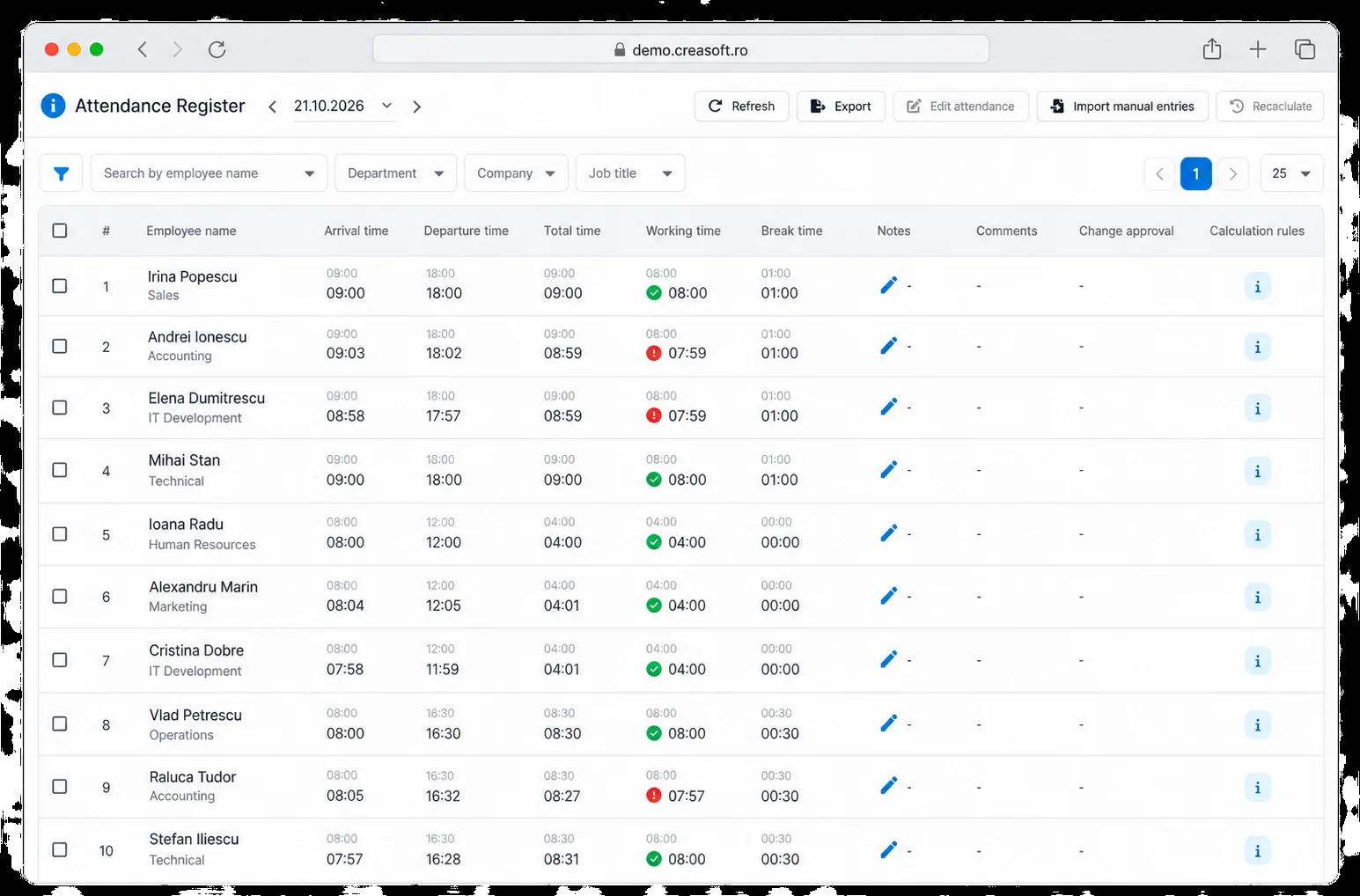
The online attendance register.
Ana clocks in with her card or phone. The register shows 07:56 and 16:04, and Wednesday’s two hours wait for approval. Corrections stay in the history.
What the law requires: for each employee and each day, the start and end time of work (art. 119 of the Romanian Labour Code). The law does not impose a specific form. The register, the timesheet, the table or the online version are ways of keeping the same record. What the law requires, in detail
The road to payroll
From the daily clock-in to the collective timesheet.
1 / Daily
The clock-in.
The start and end time, in the attendance register, on paper or online.
2 / Per employee
The timesheet.
One employee’s days in a month, with hours worked, overtime and absences.
3 / Per team
The collective timesheet.
The month’s time tracking table, for all employees, with the totals.
4 / Month end
Payroll.
Hours, overtime and absences go into the salary calculation.
Glossary
The same thing, different names.
Companies use many names for the same record. This is how to tell them apart.
| Term | What it means in practice |
|---|---|
| Attendance register | The daily attendance record, with the arrival and departure time. Traditionally, a register signed by employees. |
| Online attendance register | The same record, kept electronically: the employee clocks in with a card, phone, fingerprint or from the app. |
| Timesheet (fisa de pontaj, foaie de pontaj) | One employee’s days in a month, with hours worked and absences. The two Romanian names are used interchangeably. |
| Collective timesheet, time tracking table | The monthly summary for the whole team, used for payroll. |
| Time tracking form, time tracking template | Any ready-made template for the record above, on paper or in Excel. The law does not impose a specific template. |
| Daily timesheet | A single day, for the whole team: who came, at what time, who is absent and why. |
Free template
How to track time correctly, in five steps.
- Set each employee’s schedule: fixed, in shifts or flexible.
- Record the start and end time every day, not just the number of hours.
- Mark absences with a code: CO for annual leave, CM for sick leave, D for business trip, and so on.
- Correct only with approval and a reason, and keep the correction visible. How to check a discrepancy
- At the end of the month, compare the collective timesheet with the leave requests and approved overtime, then send it to payroll.
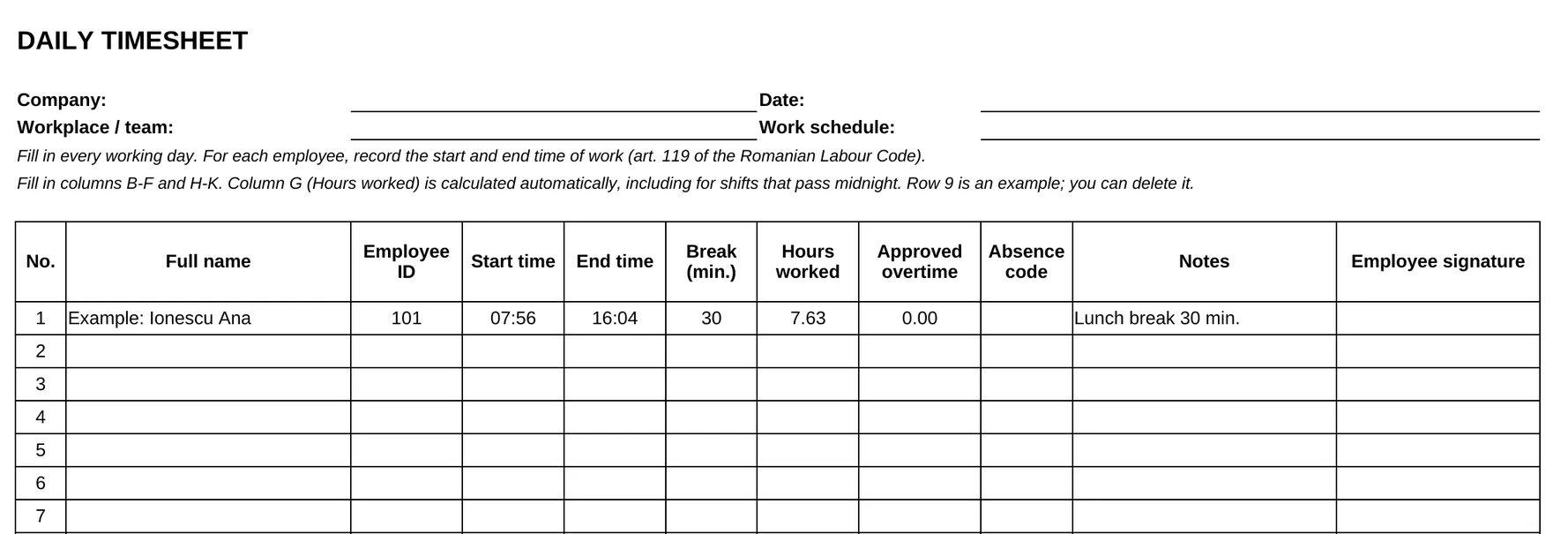
Hours worked are calculated automatically, including for shifts that run past midnight.
A simple calculation
How much time does manual time tracking cost?
An example with assumptions, not statistics: a company with 40 employees, where filling in and checking time records takes 2 minutes per employee per day. Over 21 working days: 40 x 2 x 21 = 1,680 minutes, that is 28 hours a month, almost four working days of one HR person. Put your company’s figures in their place.
Did you know?
One of the first time clocks was invented in 1888 by Willard Bundy, in Auburn, New York. The clock printed the date and time on paper, and the employer added up the hours at the end of the pay period. The Bundy company, founded in 1889, became through mergers part of the company later named IBM.
Last reviewed: 10.11.2026. Informational material; it does not replace legal analysis for your company’s situation.
Frequently asked questions.
How is employee time tracking done?
For each employee and each day, record the start and end time of work, absences with a code and approved overtime. At the end of the month, the data is added up in the collective timesheet, used for payroll. It can be done on paper, in an Excel table or automatically, with an electronic time tracking system.
What is an online attendance register?
It is the daily attendance record kept electronically. The employee clocks in with a card, phone, fingerprint or from the app, and the exact entry and exit time is saved automatically. Corrections are made with approval and stay in the history.
Is there a mandatory time tracking form?
No. The Romanian Labour Code (art. 119) requires a record of hours worked each day, with the start and end time, and its presentation during inspections, but it does not impose a specific form or template.
Can I keep time records in an Excel table?
Yes, as long as the table shows the start and end time for each day. The risks lie in how it is filled in: the table is often completed at the end of the week, from memory, and it does not show who changed a value.
What is the difference between ‘foaie de pontaj’ and ‘fisa de pontaj’?
In practice, none: both names describe one employee’s daily record over a month. The collective timesheet is something else: it summarises the whole team and is used for payroll.
Where can I find a daily timesheet template?
Download it free from this page, in Excel. It has columns for start time, end time, break and absences, and the hours worked are calculated automatically. For monthly records there is the timesheet and collective timesheet template.
Can I write only the schedule in the register, without the actual time?
It is not recommended. The CJEU judgment in case C-55/18 requires a system that measures actual working time, day by day. If you write only the schedule, for example 08:00-16:00, late arrivals and extra hours are lost, and they matter for pay and in an inspection.
How is time tracking done for field or remote employees?
Field employees can clock in with their phone, from the app. Hours worked are recorded for remote work too. Details in the guide to remote work.
Time tracking, with no manual entry.
Creasoft generates the attendance register and the collective timesheet from clock-ins, from EUR 1 per employee per month.
Or call sales: +40 749 500 400