
Home / HR guides / Workforce planning
HR guide
Workforce planning. The right people, at the right time.
Workforce planning answers two questions: how many people, with which skills, you need, and how you fit them into shifts and schedules. The first is decided over years, the second over weeks.
Last reviewed: 10.11.2026
Two levels
Over years and over weeks.
Strategic / 3-5 years
How many people and which skills.
Start from the company’s plans: new locations, production, retirements, departures. The usual horizon is 3-5 years.
Operational / weeks
Who works, and when.
Shifts, leave and business trips, so that every post is covered, within the legal limits on working time and rest.
Step by step
Workforce planning, in six steps.
The stages commonly used in HR practice, from context to follow-up.
1 / Context
Where you start.
The company’s objectives and external factors: the market, legislation, the local labour market.
2 / Supply
The people you have today.
Headcount, working hours, skills, length of service, turnover and absenteeism.
3 / Demand
How many you need.
The people and skills needed for the objectives of the coming periods.
4 / Gap
What is missing.
Compare what you have with what you need, by post, location and skill.
5 / Plan
How to close the gap.
Hiring, training, internal moves, contractors or reorganising shifts.
6 / Follow-up
What you check every month.
The plan is tracked and adjusted, based on real data from time tracking and employee files.
The data
The data you need, already in the system.
| Indicator | Where you get it |
|---|---|
| Headcount and working hours | The digital employee file |
| Hours worked and overtime | Electronic time tracking and the collective timesheet |
| Absenteeism and leave | The attendance register and leave requests |
| Turnover | Contract history: departures relative to the number of employees |
| Shift coverage | The shift planner |
The legal limits
The shift plan complies with the Labour Code.
The basic rules for operational planning in Romania.
| Rule | What it provides | Labour Code |
|---|---|---|
| Normal working time | 8 hours a day and 40 hours a week. | art. 112 |
| Maximum working time | 48 hours a week, including overtime, as an average over the reference period. | art. 114 |
| Daily rest | At least 12 consecutive hours between two working days; in shift work, at least 8 hours between shifts. | art. 135 |
| Weekly rest | 48 consecutive hours, usually Saturday and Sunday. | art. 137 |
| Overtime | Compensated with paid time off; if that is not possible, paid with a premium of at least 75% of the base salary. | art. 122-123 |
Last reviewed: 10.11.2026. Informational material; it does not replace legal analysis for your company’s situation.
Frequently asked questions.
What is workforce planning?
Workforce planning means working out how many people, with which skills, the company needs, where and when. In the long term it is tied to the company’s strategy; in the short term it becomes the planning of shifts, leave and business trips.
What is the difference between workforce planning and shift planning?
Workforce planning sets how many people and which skills you need, over years. Shift planning places the people you have into schedules, by day and week. The second puts the first into practice.
What data do I need for workforce planning?
Headcount and working hours, hours worked and overtime, absenteeism and leave, turnover and shift coverage. In HR software, most of it comes directly from time tracking and the digital employee file.
How many hours can an employee work per week?
Normal working time is 40 hours a week (art. 112 of the Romanian Labour Code). The legal maximum is 48 hours a week, including overtime, calculated as an average over the reference period (art. 114).
How much rest is required between two shifts?
At least 12 consecutive hours between two working days. By exception, in shift work, rest cannot be less than 8 hours between shifts (art. 135 of the Romanian Labour Code).
How is overtime compensated?
With paid time off. If it cannot be compensated within the legal deadline, it is paid with a premium set by contract, of at least 75% of the base salary (art. 122-123 of the Romanian Labour Code).
How does Creasoft HR help with planning?
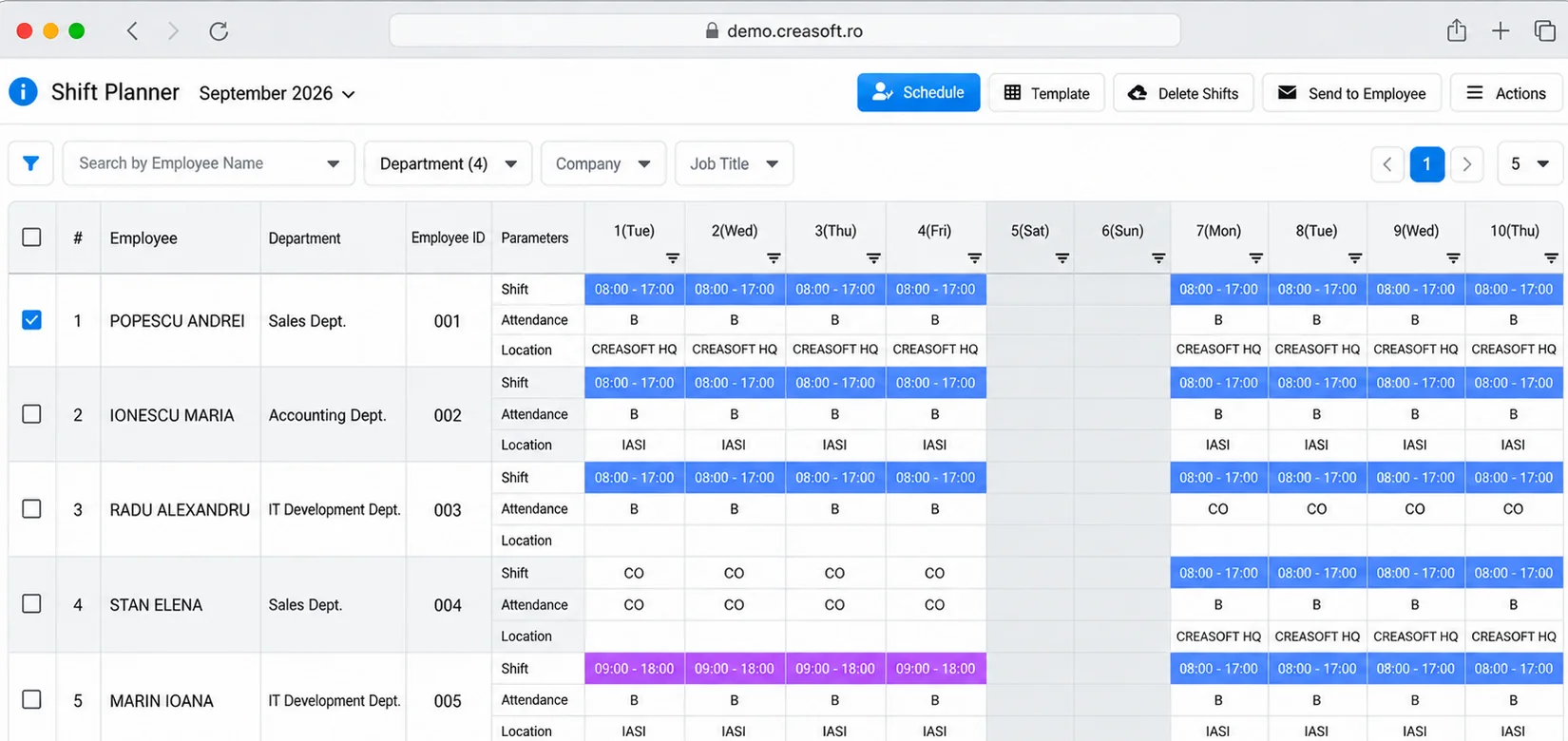
The shift planner applies schedule templates to employees and is linked to time tracking. Leave and business trips appear in the same calendar, and overtime appears separately and is approved. The data for long-term planning comes from time tracking and the digital employee file.
Plan once. See deviations immediately.
Shifts, leave and overtime, linked to time tracking, in Creasoft HR.
Or call sales: +40 749 500 400